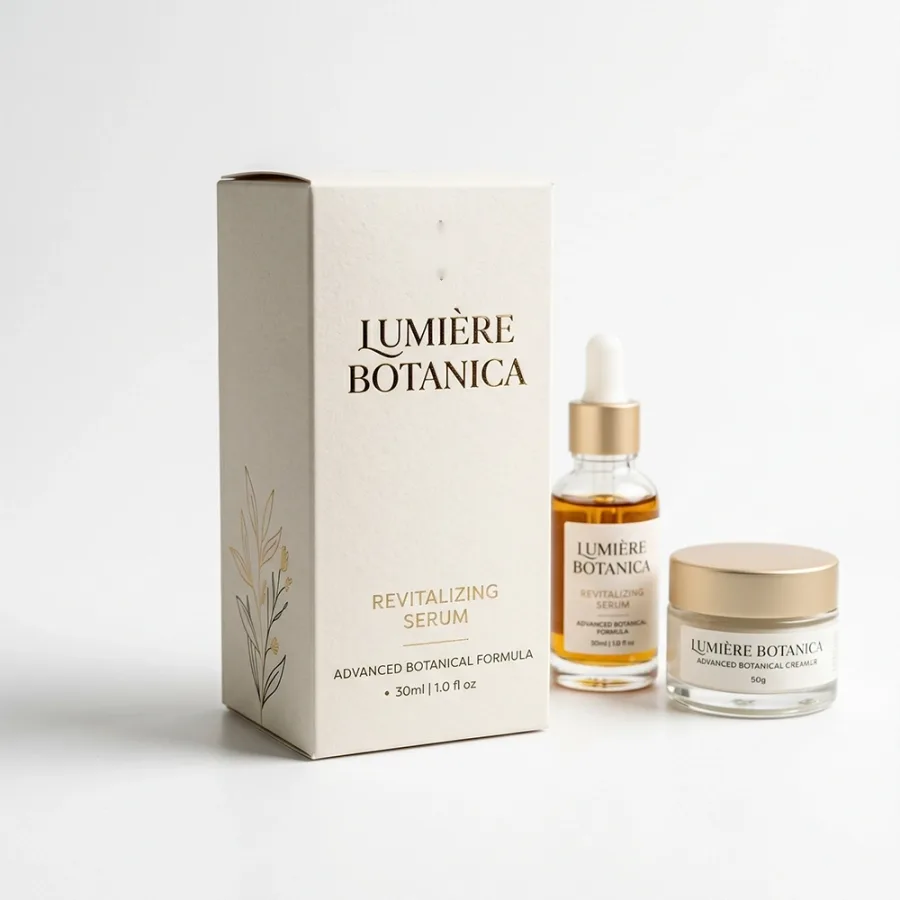
Packaging guide
Packaging Checklist for Launching a UK Skincare Brand
What a new skincare brand needs on its boxes before the first batch: panels, barcodes, inserts and timing.
Where does packaging sit in a skincare launch?
Later than it should.
Most new brands get the formula, the bottle and the website done, then find the box is the thing holding up the launch date. A carton takes about two weeks from measurements to delivery, and that is after the artwork is finished.
This checklist works backwards from the day stock needs to be boxed. It covers the measurements, the panels, the codes, the inserts and the quantities, in the order they need deciding.
It is a packaging checklist, not a legal one. UK cosmetic labelling rules exist and the brand is responsible for meeting them; a cosmetic safety assessor or your own adviser tells you what the label must carry. The box has to leave room for whatever that turns out to be.
What do you need before you can order a box?
Four things, and the box cannot be drawn without any of them.
The first is the final container, in your hand, with its closure. Not a supplier listing; the actual bottle, because listings round sizes and closures change height.
The second is the product list. A launch of three products needs three dielines, or two if a pair of containers share a size. The third is a logo in vector format. The fourth is a decision on where the product sells, because a shelf box and a parcel box are different builds.
With those four in place the quote is quick. The skincare packaging range lists the six box types most launches draw from.
- Final containers with closures, in your hand
- The product list with sizes, in millilitres and millimetres
- A logo as a vector PDF, AI or SVG
- The shelf or parcel decision for each product
- The text that must go on each box, as a document
- A rough quantity per product for the first batch
How should the panels of a skincare carton be laid out?
A folding carton has five printable faces: front, back, two sides and a top flap, plus a base.
Each one has a job, and the launch goes smoother if the job is decided before the designer starts.
The front takes the brand, the product name and the size in millilitres, and nothing else. The back carries the description, the ingredients list, directions and warnings. One side carries the batch code and the barcode; the other carries contact details and any symbols the label needs.
The table gives a working layout for a 37 x 37 x 110 mm serum carton. Panel widths are the inside box size; printable height is a few millimetres less because of the flaps.
| Panel | Carries | Space on a 37 x 37 x 110 mm carton |
|---|---|---|
| Front | Brand, product name, volume | 37 x 105 mm |
| Back | Description, ingredients, directions | 37 x 105 mm |
| Left side | Batch code area, barcode | 37 x 105 mm |
| Right side | Contact details, symbols | 37 x 105 mm |
| Top flap | Logo or product name repeated | 37 x 37 mm |
| Base | Nothing, or a batch code stamp area | 37 x 37 mm |
How much space does an ingredients list need?
More than most first layouts allow.
A typical serum has 20 to 35 ingredients, which at a readable 6 pt runs to 8 to 12 lines on a 37 mm wide panel. Two products in one range can have very different list lengths, so lay out the longest one first.
The usual fix for a small carton is to split the text between the back and one side, or to use a slightly taller carton than the bottle needs. A 5 mm increase in height gives another two lines on every panel.
Set the list in a plain typeface, dark on light, and do not reverse it out of a dark background below 7 pt. Your assessor or adviser confirms what the list must include; the designer's job is to make it fit and stay legible.
Where do the batch code and barcode go?
The batch code is the one thing on the box that changes with every production run of product, so it is almost never printed with the artwork.
Leave a clear area, about 25 x 8 mm, on a side panel or the base, and stamp or label it when the product is filled.
A barcode is printed with the artwork because it does not change. A retail barcode at full size is about 37 x 26 mm including the quiet zone around it. On a small carton it can be reduced to around 80 per cent and still scan. Place it on a flat panel, never across a crease, and print it in black on white or a very pale colour.
If you do not have barcodes yet, leave the space anyway. Adding one later means a new proof and a new print run.
Which products need an insert or a window?
For a launch that sells online, inserts matter more than windows.
A 30 ml dropper bottle in a snug carton travels well on its own. A 50 ml glass jar benefits from a card collar. A 200 ml lotion bottle wants a base insert so it cannot shift.
Windows are a shelf decision. If the first stockist is a shop or a clinic, a window on the serum carton shows the bottle. If the first year is online only, skip it and keep the carton stiff.
The cream jar boxes built with a collar are the one most launches add first, because jars are the heaviest item in the range.
How many boxes should a first batch order?
Order to the product batch, not to the sales forecast.
If the first fill is 300 units of serum, order boxes for 300 plus a margin of about 10 per cent for damaged, sampled and photographed units. Quantities are quoted per order, and everything starts from £0.25 per unit.
Ask for two or three quantities on the same quote, for example 300, 500 and 1,000, and compare the unit price. The drop between the first two is usually larger than between the second two.
Keep the artwork files from the proof. A reorder at the same size and print goes straight to production without a new proof, unless something has changed.
What is the timeline from artwork to boxed stock?
Count back from the day the product is filled and needs boxing.
These are the steps and the time each one takes when nothing goes wrong.
- Containers in hand, measured and photographed: day 0.
- Quote requested with sizes, quantities and finishes; written quote back within one business day.
- Artwork finished and sent, with label text supplied by your adviser; allow a week for this on your side.
- Free design proof received; one round of changes is normal, so allow two to three days.
- Proof approved; production takes 4 to 6 business days.
- Delivery, free and tracked, adds 2 to 3 business days; boxes are on site about two weeks after approval, and earlier if the artwork was ready at day 0.
What do first-time skincare brands get wrong on the box?
The same handful of things, launch after launch.
None of them is expensive to fix at the proof stage and all of them are expensive after printing.
The one that costs most is changing the bottle after the box is printed. Lock the container before the artwork starts. For launches posting direct to customers, the cosmetic mailer boxes with a card insert solve the next most common problem: a perfect carton arriving crushed in a padded bag.
- Approving a proof before the label text is final
- Leaving no stamp area for the batch code
- Setting the ingredients list too small to read
- Choosing soft touch lamination on a design with fine white type
- Ordering boxes for the forecast rather than the fill
- Changing the bottle supplier after the dieline is drawn
What does a launch-ready box look like?
Front panel with three things on it.
Back panel with the text that your adviser signed off, at 6 pt or larger. A barcode on a flat panel and a clear stamp area for the batch code. A board that carries the filled weight, and an insert where the container is glass.
A proof that someone has read on paper, not just on a phone, with every panel checked against the dieline. And a quantity that matches the product batch with a margin.
If every line above is ticked, the box will not be what delays the launch. Send the measurements and the product list and the quote comes back within a business day.