Does a perfume drawer box have a ribbon pull or a notch?
Either. A ribbon tab glued to the tray front is the usual choice; a thumb notch cut in the sleeve costs nothing extra. Both can be combined on a heavy tray.
Written prices from £0.25 a box. Free proof, made in 4–6 business days, free tracked UK delivery.
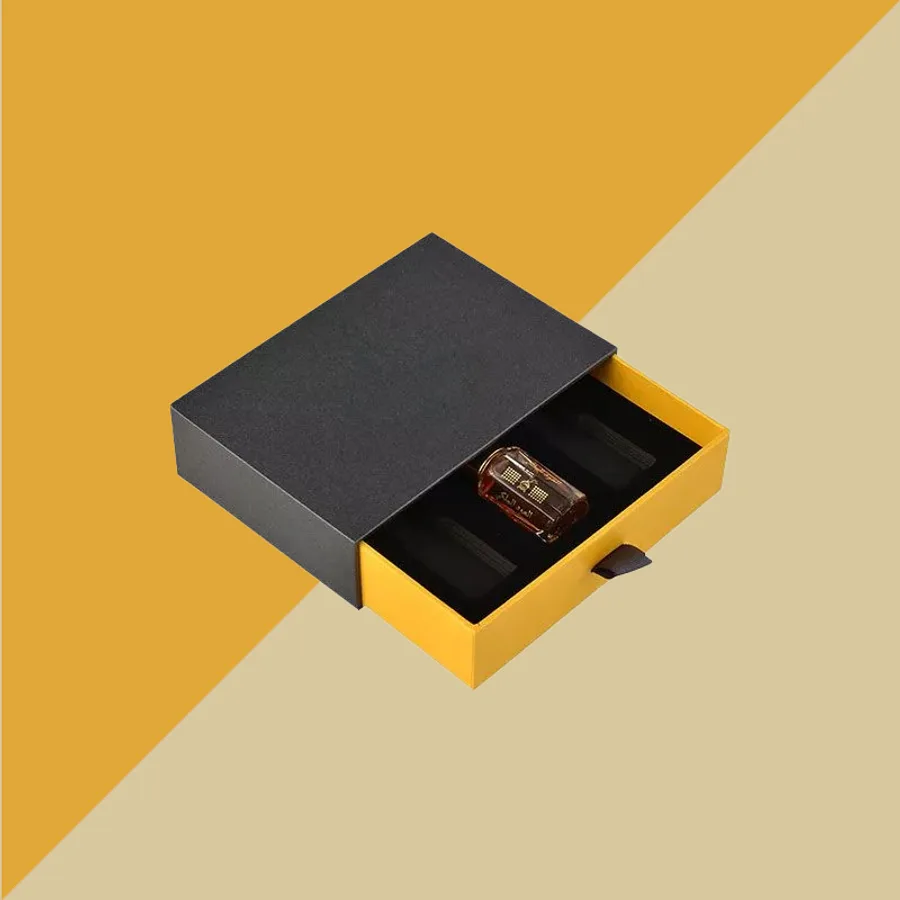
A rigid outer sleeve and an inner tray that slides out on a ribbon pull, with the bottle held in a cut insert. Print the sleeve in one colour and the tray in another, or match them both.
| Container | Typical box size |
|---|---|
| 12 ml oud oil bottle | 95 x 70 x 40 mm |
| 30 ml spray laid flat | 110 x 80 x 45 mm |
| 50 ml spray laid flat | 150 x 100 x 60 mm |
| 100 ml spray plus 10 ml mini | 190 x 120 x 65 mm |
Perfume drawer boxes are two-part rigid boxes: an outer sleeve and an inner tray that slides out like a drawer.
The bottle sits in a foam or card insert inside the tray, and a ribbon tab or thumb notch is used to pull it. They are made to your bottle, printed on both parts, and confirmed on a written quote.
Picture a matchbox scaled up and made in thick board.
The outer part is a sleeve open at one end. The inner part is a tray with low walls that slides into it.
Pull the ribbon and the tray glides out to show the bottle lying in its insert. Push it back and the box is closed, with no lid to lose and nothing to unfold.
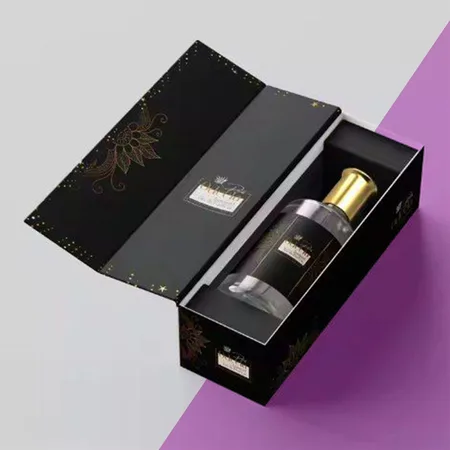
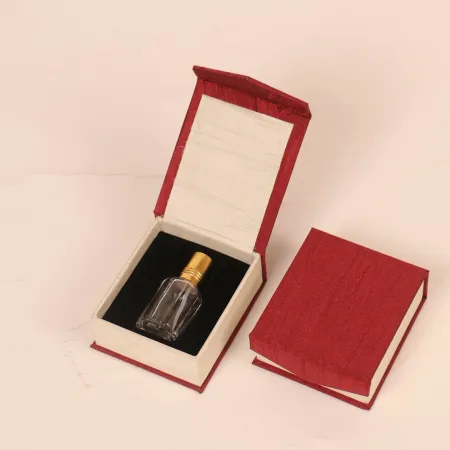
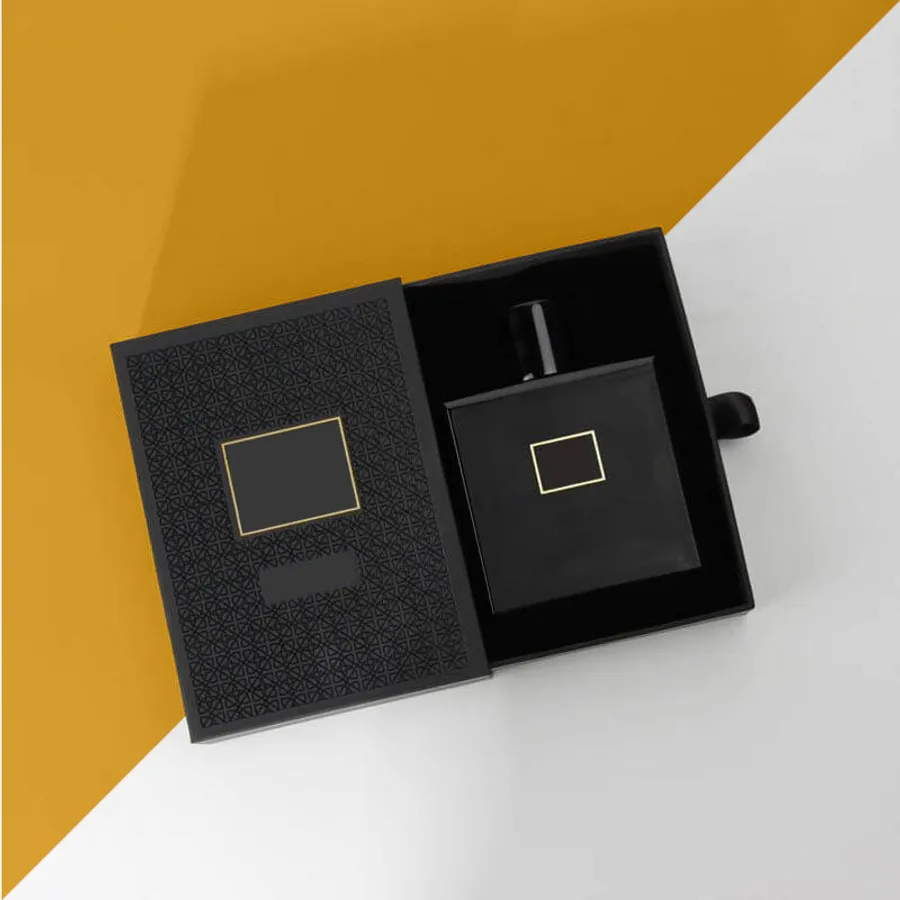
The photos on this page show the two-colour version most brands ask for. That is a dark sleeve with a bright tray, or a patterned sleeve with a velvet-look tray.
Oud and attar sellers were early adopters.
A 12 ml oil bottle lying in a black velvet-look well, revealed as a yellow tray slides out, is a familiar sight in UK fragrance shops.
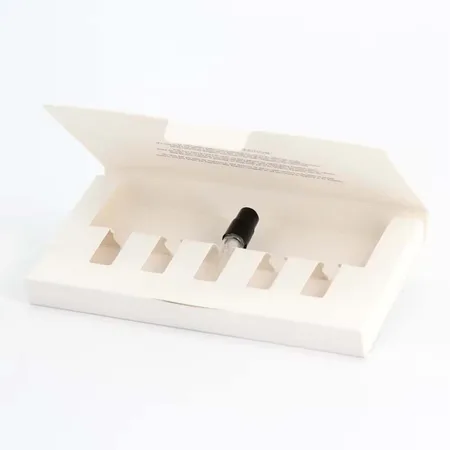
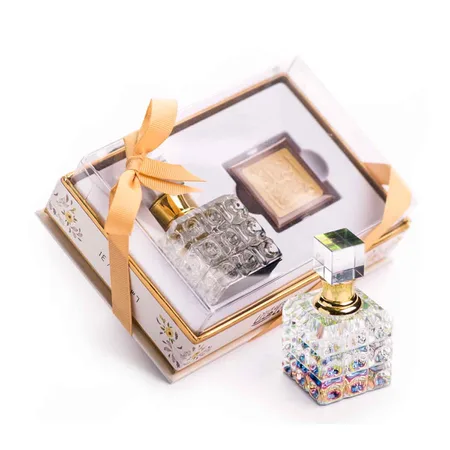
Perfume houses use the drawer for a bottle-and-mini pairing, since the tray can hold two wells side by side. Subscription and discovery sellers use a shallow drawer for a row of vials.
Gift shops like it because a drawer box needs no wrapping and still feels like a present. The perfume gift boxes for presenting sets page covers the lid-and-base alternative.
A ribbon tab is a short loop of grosgrain or satin glued into the front wall of the tray.
It is easy to grip, looks finished and can match a brand colour.
A thumb notch is a half-moon cut in the sleeve edge that exposes the tray so a thumb can push it. It costs nothing extra and suits a minimal design.
Some brands add a finger hole in the back of the sleeve so the tray can be pushed from behind. All three are options, and we show the one you choose on the proof.
| Opening | How it looks | Best for |
|---|---|---|
| Ribbon tab | A short loop on the tray front, in a chosen colour | Gift boxes, oud oils, anything shown in the hand |
| Thumb notch | A half-moon cut in the sleeve edge | Minimal designs, lower cost, retail shelves |
| Rear finger hole | A round hole in the closed end of the sleeve | Heavier trays that need a push rather than a pull |
| Notch plus ribbon | Both, for a tray that is deep or heavy | 100 ml bottles with a mini and a card |
Drawer boxes almost always lay the bottle flat, so measure its length with the cap on, its width and its depth.
A 50 ml bottle of 120 x 50 x 50 mm lies in a tray about 140 x 80 x 50 mm inside.
Add the sleeve and the insert walls and the outside is about 150 x 100 x 60 mm. For a bottle and a 10 ml mini side by side, add about 40 mm to the width.
Depth matters more than it does on a carton. A tray too shallow lets the bottle stand proud and the sleeve will not slide over it. Give the cap 3 to 5 mm of clearance.
Both parts are rigid greyboard, about 1.5 mm for the tray and 2 mm for the sleeve, each wrapped in printed paper.
The sleeve is built a fraction larger than the tray so it slides without catching.
That tolerance is the skill in a drawer box. Too loose and the tray rattles; too tight and it jams when the paper wrap swells in a damp stockroom.
Board, rigid and finish options are available on request. Our guide to drawer, sleeve and magnetic styles explains how the drawer compares with a sleeve-and-tray carton.
Two parts means two print areas.
Many brands keep the sleeve dark and plain with a foil mark. The tray and its insert then go in a bright colour so the opening has contrast.
A pattern can run around the whole sleeve. The open end can be printed inside too, so no bare board shows when the tray is out.
Matt lamination, soft touch, foil stamping and spot UV are all options on the wrap. Embossing suits the sleeve top, which is the flat face shown on a shelf.
The insert is the floor of the tray, with a well cut to the bottle's outline.
Foam with a black or coloured flock gives the velvet-look well seen in the photos. Card inserts wrapped in paper are a lighter option.
Wells can be cut for the bottle, a mini, a card and a sample vial together. Each well is sized so the item lifts out with a fingertip but does not slide in transit.
Inserts are on request and shown on the proof before anything is cut. For a tray of several small bottles, the perfume sample and discovery box page shows the vial layouts that work.
They arrive assembled with the tray inside the sleeve.
A snug tray does not fall out when the box is upended, but we pack them with the open end facing inwards all the same.
For posting to a customer, put the drawer box in a mailer with light padding. The sleeve edges are the part that scuffs if a parcel rubs in a van.
Store them flat, not on end, so the sleeve does not slowly go out of square under its own weight.
Choosing a tray colour that fights the sleeve is the usual one.
A good drawer box has one bold colour and one quiet one, not two bold ones.
Forgetting the inside of the sleeve is another. When the tray is pulled, the sleeve's inner face shows, so print it or at least colour it.
The last is sending bottle measurements standing up when the bottle will lie down. State the orientation and we size the tray to it.
The process is the same whether you need a box for one oud oil or a bottle-and-mini set.
Prices start from £0.25 per unit, quantities are quoted per order, and the figure is confirmed in writing.
The quickest route is a WhatsApp photo of the bottle next to a ruler, or an email to info@thecosmeticpackaging.co.uk with the measurements.
Call +44 7578 382054 if you would rather talk it through.
Or use the quote request form for drawer boxes and we reply with a written quote and a dieline.
Choose a real photo of the box you have in mind, put your logo on it, pick a colour and finish, and send it over. Our designers turn it into a free, print-ready proof.
The more we know about what goes inside, the bottle or jar, the quantity and the look you are after, the sharper the price. A packaging specialist replies within one business day with a written quote and a free design proof.
Not answered here? Call +44 7578 382054, message our packaging team on WhatsApp or email info@thecosmeticpackaging.co.uk.
Either. A ribbon tab glued to the tray front is the usual choice; a thumb notch cut in the sleeve costs nothing extra. Both can be combined on a heavy tray.
Yes, the insert is cut with two wells side by side. Add about 40 mm to the box width for a 10 ml mini beside a 50 ml bottle.
Yes, and most are. A dark sleeve with a bright or velvet-look tray is the most requested pairing.
A correctly fitted tray stays in the sleeve when the box is turned over. It needs the ribbon or notch to start it moving.
Bottle depth plus the insert floor plus 3 to 5 mm clearance above the cap. A 50 mm deep bottle usually ends in a box about 60 mm tall outside.
Yes. The inside face of the sleeve shows when the tray is pulled, so printing or colouring it is an option worth taking.
Yes, both the sleeve and the tray are greyboard, about 1.5 to 2 mm, each wrapped in printed paper. Board options are confirmed on your quote.
A window cut-out in the sleeve top is possible, lined with clear film. It shows the bottle without pulling the tray.
Foam with a flocked finish or a paper-wrapped card insert, each cut to the bottle. Both are available on request and shown on the proof.
Yes, they arrive built, with the tray inside the sleeve and the insert glued in. Store them flat so the sleeve stays square.
Four to six business days after you approve the free proof, plus two to three business days for free tracked delivery in the UK.
No fixed number. Quantities are quoted per order, from £0.25 per unit, and the written quote confirms the figure for your run.